

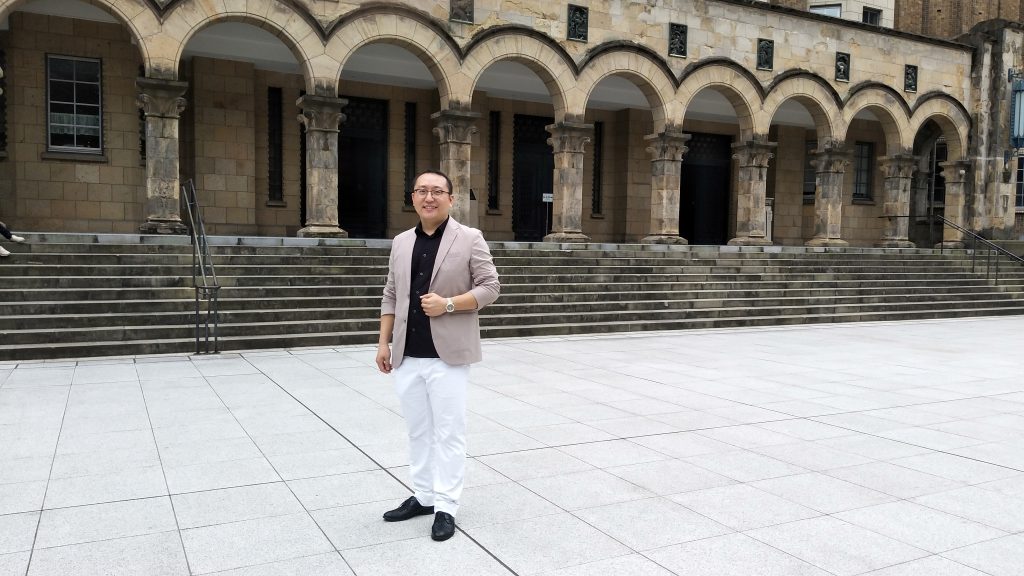
Feng Lei: PhD, Special Researcher for Foreign Nationals at the University of Tokyo, Associate Professor in the Department of Chinese Language and Literature, Supervisor for Master’s Students in Foreign Languages and Literatures, Member of the Chinese Writers’ Association, and Director of the Japanese Association of Chinese Writers.
Me: Professor Feng, from an academic perspective, how would you define poetry and literary merit?
Professor Feng: Though many have attempted it, modern poetry currently lacks a universally accepted definition. We can only say it should embody certain fundamental characteristics: formally, it should employ line breaks, construct imagery, and avoid prose-like, continuous narrative styles. Its tone and vocabulary primarily consist of refined modern colloquial language.
Me: How should we appreciate poetry written by ordinary people?
Professor Feng: First, we must recognise that poetry bears no inherent connection to the author’s background; indeed, outstanding poets can be found across all walks of life.
If by “ordinary people” we mean those with little creative experience, the focus should typically be on the emotions expressed.
Me: Given the extreme freedom of modern poetic forms, where exactly lies the boundary between literary and non-literary writing?
Professor Feng: It must be clarified that formal freedom is indeed a challenge. This does not imply creation has become simpler, but rather more difficult—crafting a “good poem” is harder than ever. Classical poetry offered metrical frameworks to rely upon; mastering these conventions enabled the creation of a competent verse. Modern poetry operates in direct contrast. This is both the fortune and the shortcoming of contemporary verse.
The boundary between literature and non-literature has nothing to do with formal concerns. No one would mistake a press release for a literary work, nor would anyone regard prose as non-literary. The dividing line between literature and non-literature ultimately lies in subjective lyricism.
Me: Do poems written by ordinary people hold any aesthetic value?
Professor Feng: As previously stated, a poem’s artistic merit is independent of the author’s social standing. The poetry of so-called “ordinary people”—or popular verse—certainly possesses appreciable value. Consider the poems that emerged during revolutionary struggles; many exerted profound influence, resonating deeply within their specific contexts. We cannot dismiss their significance.
Therefore, the definition and evaluation of poetry should transcend form and identity, returning to the essence of emotion and literary merit.
Poem:
Forever be my springtime
Where is spring?—
Only grown-ups ask such silly questions
Look at my two-year-old daughter
She doesn’t yet understand what spring is
Yet every day she’s as joyful as a bird
When Granny teases her, she tilts her head and winks
Making Granny laugh like a child
Who is teasing whom, after all?
Is it me taking her to the park to ride the miniature train
Or is she pulling me back to my childhood?
Stay my spring forever, won’t you?
Just as my mother used to say to me:
“You mustn’t grow up,
Nor must Mummy grow old.”
Won’t you?
Dorothy runs through the Black Forest
Dorothy hasn’t folded the witch’s crisp white shirt
Dorothy ran desperately through the Black Forest
The grass in the Black Forest caught the scent of orchid wine
The flowers in the Black Forest recalled yesterday’s frolics
Dorothy ran through the Black Forest
If only she could wade across the stream ahead
—Dorothy waded desperately across the stream
If only she could climb the high hillside
—Dorothy scrambled up the steep mountainside
Weeping, Dorothy longed to reach the summit and gaze down below
Like the warm mist on the windowpane while cooking
Or the chocolate-scented snores beneath the bedside photograph at night
Two pine trees on the mountaintop cast spear-like silhouettes
Boom—the moon puffed out its cheeks, perched between the spears
Dorothy stood on tiptoe, reaching for the moon with her tongue.
The pine bark was black and dry.
The moon was cool, with a hint of sorrowful sweetness.
Until the moon bled, like a shallow stream.
Dorothy folded herself up.
Beneath the moon, in the forest,
the timid lion licked his brave heart.
