


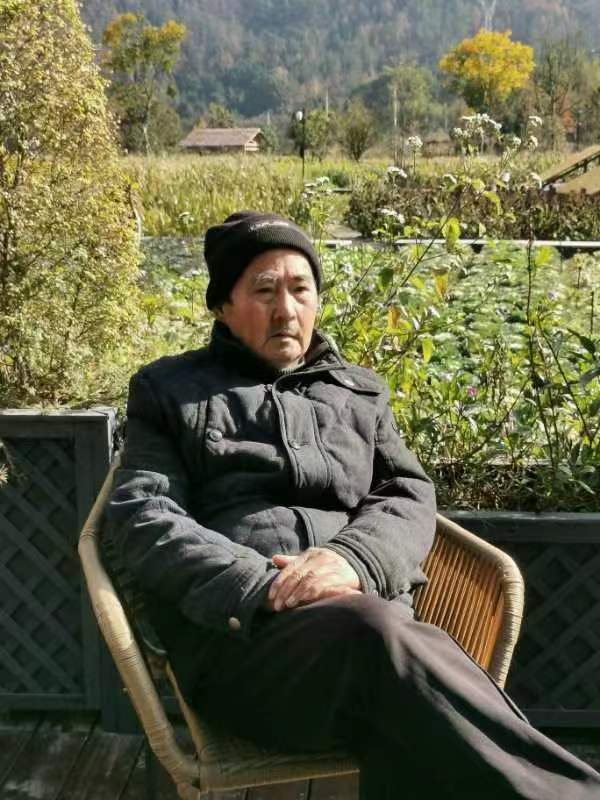
Mr Wu, born 1953
Occupation: Farmer / Member of Zhejiang Province Poetry Association
Self-designation: Rustic labourer
Education: Primary school
Me: Mr Wu, how did you first become involved with poetry?
Mr Wu: It stems from a deep-seated affection, I suppose.
I completed primary school in 1965, but the Cultural Revolution soon followed, forcing me to abandon my studies. Thereafter, I learned crafts from my father—painting and carving. In the late 1960s, while practising my trade in Guotan Pianwan Village, Guanlu Town (now submerged by a reservoir), I encountered Mr Zhang Tan, an enlightened villager who composed poetry and was close to my father’s generation. I once asked him, “Uncle, how does one write poetry?” Mr Zhang gifted me this saying: “Read the Three Hundred Tang Poems thoroughly, and even if you cannot compose verse, you will learn to recite it.” Yet in those days, ancient texts were banned as part of the ‘Four Olds’, and classical poetry was no exception. Opportunities to encounter classical verse were scarce, but whenever I could, I would seek out such works to read and recite. It wasn’t until after 1987 that Xinhua Bookstores began selling Tang and Song poetry collections. Driven by a thirst for knowledge, my family, though of peasant origin and straitened means, subscribed to periodicals like Wenhui Monthly and Reportage Literature to cultivate literary refinement. We also read authoritative newspapers such as the Global Times, consulting dictionaries for unfamiliar words. I still vividly recall reading a piece of reportage by Tao Shuliang, daughter of Tao Zhu (former Vice Premier of the State Council, writer, and poet), entitled My Father, Tao Zhu. It was beautifully written.
Me: Why did you develop a fondness for poetry?
Mr Wu: Back then, I didn’t understand how to compose verse, nor did I grasp the principles of metrical poetry or the intricacies of tonal patterns. Without formal instruction, I simply recited and chanted. I was captivated by the rhythmic beauty of the language in poetry and lyrics, which possessed a melodic charm akin to song. That’s how I came to love verse.
Me: You mentioned leaving school after primary education. How then did you learn to write poetry?
Mr Wu: My passion for poetry sparked an unquenchable interest. In 2010, at age 57, I happened upon Mr Li Xifan while touring ancient dwellings in Lizhai Village. His calligraphic poems adorned the wooden walls of his home. I studied them intently! When Mr Li asked if I enjoyed poetry, I nodded eagerly: “I love it, but I can’t write it.” He informed me that the White Pagoda had a poetry society and suggested I attend when time permitted. Thus began my journey into learning poetry. At that time, meetings were held monthly for members to exchange verses, and I attended every session. When inspiration struck, I would practise writing. I would then seek feedback on my compositions from friends, teachers, and seniors. This continuous process helped me steadily improve my creative skills.
Xianju is a place of outstanding natural beauty, with picturesque scenery everywhere. Now, when I have time, I hike through the lovely landscapes of my hometown. When inspiration strikes, I write little poems to express my feelings. In my old age, poetry is my entertainment. To spend my twilight years in carefree contentment – why not?
Me: You mentioned being a farmer with training in crafts (carving, painting). How do you feel your work has inspired your poetry? Or rather, what connection exists between your profession and your verse?
Mr Wu: No inspiration, no connection. Merely a means to cultivate one’s character. As the elders say: “To learn poetry, one must first learn to be human.” Poetry can sometimes inspire, as Li Bai put it: “Heaven has given me talents for a purpose,” and so forth. Thus, I’ve formed an inseparable bond with verse.
poetry:
鹧鸪天.仙居行吟
今作仙都山水郎,翠微畅赏任疏狂。追踪潘耒成新客,策杖虹桥览故乡。
逢佳境,自难忘,勾留迷醉亦寻常。壮心不已溪山路,抬望云天夕照光。
采桑子.神仙居
人间自有丹丘地,
远岫含烟。
飞瀑高悬,
云雾苍茫海日边。
峰峦叠嶂钟神秀,
鹤舞松前 。
莫问流年,
人在山中便是仙。
春过如意湖
掬水蓬莱辟一湖,俯看白塔嵌明珠。
亭台舞榭春花满,疑是东风作画图。
乙巳初秋独上谷坦水库
烟笼空翠秀氤氲,
百嶂千峰秋色分。
闲上高山看野水,
偏宜湖底荡孤云。
当年村落家何在,
此日风光客可欣。
策杖长堤行不足,
沧浪一曲喜相闻。
题浙江农林大学
院内瑶池物外新,
霞光旖旎半城春。
松风雪夜芸窗苦,
柳影婆娑追梦人。
访临安博物馆
馆外清波月一钩,
凭谁传语说王侯。
几多故事烟云散,
风物无声迹永留。

